 WEARLETS

Does Cotton Shrink? How Much, Why It Happens & How to Prevent It
In this cotton shrinkage guide
- Does cotton shrink?
- Why cotton shrinks
- How much cotton shrinks
- Does 100% cotton shrink?
- Washer, dryer, hot and cold water
- Cotton shirts and T-shirts
- How to shrink a cotton shirt
- How to prevent shrinkage
- Can you unshrink cotton?
- Cotton-polyester blends
- Ring-spun, Pima, Supima & organic cotton
- How manufacturers control shrinkage
- Cotton shrinkage FAQs
Does Cotton Shrink?
Yes. Cotton can shrink, but the useful answer is more specific: cotton garments change dimensions when the fabric is allowed to relax or is forced into a more compact state during washing, drying or finishing. The result depends on the yarn, fabric structure, processing history and care method.
CottonWorks, the technical education platform from Cotton Incorporated, defines shrinkage as a dimensional change that produces a loss in a fabric or garment dimension. Its technical guidance also stresses that shrinkage is influenced by fabric construction, wet processing, finishing, garment manufacturing and care. See the CottonWorks shrinkage and skewing resource.
Why Does Cotton Shrink?
Cotton fibers do not simply “melt smaller” in hot water. The bigger story is structural. During spinning, knitting, weaving, dyeing, drying, finishing and garment making, yarns and fabrics can be held under tension. When water, heat and mechanical action are introduced later, some of those stresses can relax.
Moisture allows relaxation
Water changes the way cotton fibers and yarns interact. A fabric can move toward a more relaxed structure once it becomes wet, especially if residual processing stress is still present.
Mechanical action consolidates fabric
Agitation in a washer and tumbling in a dryer can help yarn loops and intersections settle closer together. This is one reason tumble drying can create more dimensional change than gentle air drying.
Heat can intensify the process
Higher-temperature washing and drying can increase the chance of noticeable shrinkage, especially in cotton that has not been adequately stabilized before the garment is sold.
Fabric structure matters
Knit structures are generally more open and flexible than many woven structures. CottonWorks notes that knits are inherently more prone to dimensional instability than wovens, which is important for T-shirts, polos and sweatshirts.
This explains why two shirts labeled “100% cotton” can behave differently. A lightweight single-jersey T-shirt, a compacted heavyweight jersey, a piqué polo and a woven Oxford shirt have different structures and processing histories.
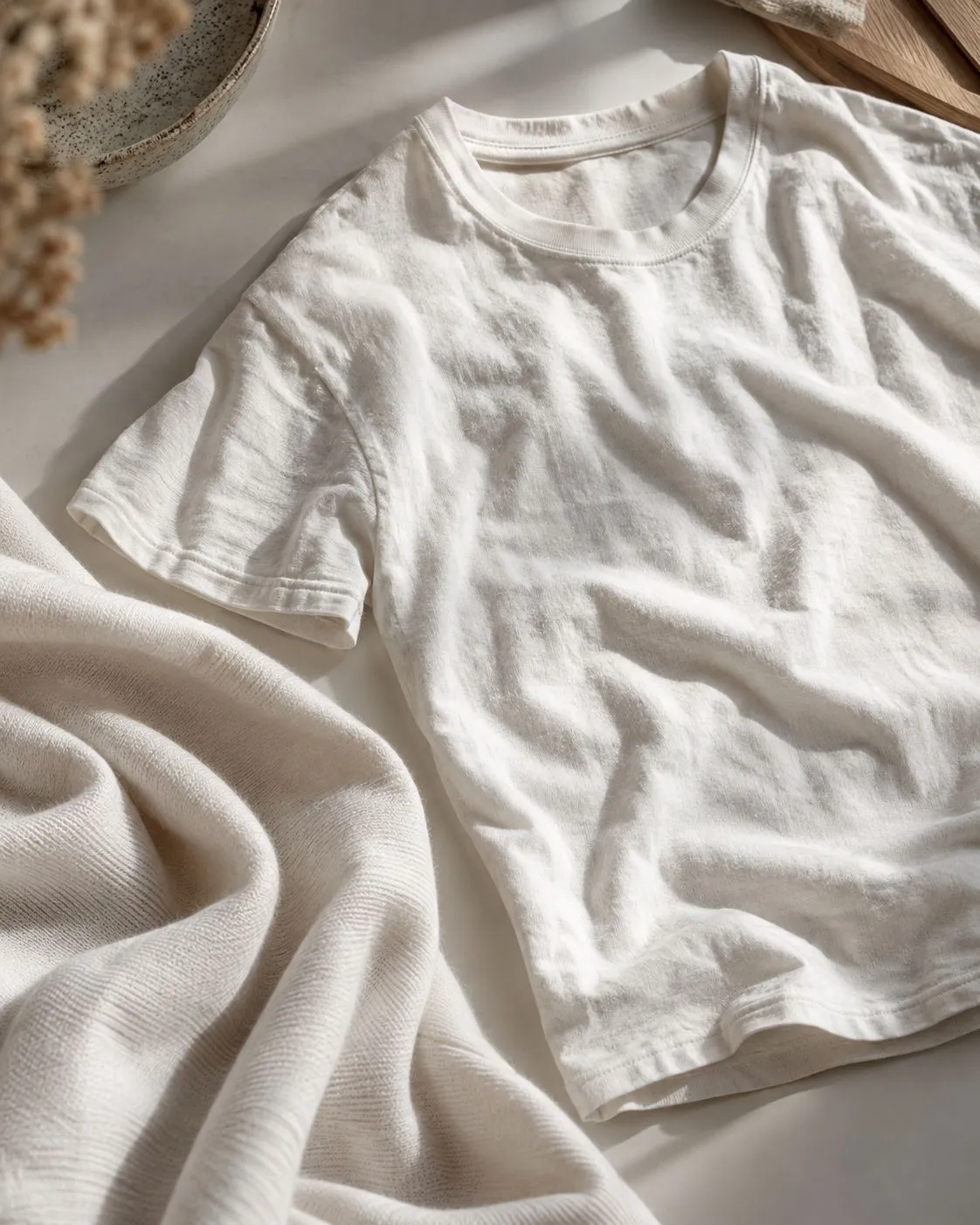
Why cotton texture changes after washing
Natural cotton can look and feel slightly different after laundering because the fabric relaxes from its processed state. That small structural change is the reason many people notice that a cotton T-shirt feels denser, shorter or more compact after washing and drying.
Soft jerseys, especially lightweight or untreated knits, can show this effect more clearly than tightly stabilized fabrics. That is why fabric finishing matters just as much as the fiber label.
How Much Does Cotton Shrink?
There is no honest single percentage that applies to every cotton garment. Search phrases such as how much does cotton shrink, how much does 100 cotton shrink and how much do cotton shirts shrink sound like they should have one number, but textile testing is more precise than that.
Manufacturers normally measure dimensional change separately in the garment length and width after a defined wash-and-dry procedure. CottonWorks notes that a result written as, for example, “5 × 5%” means 5% in one direction and 5% in the other; the two figures are not averaged together. The same source emphasizes that jersey, rib and piqué constructions can perform very differently.
| Garment / fabric | Typical shrinkage sensitivity | Why results vary |
|---|---|---|
| 100% cotton jersey T-shirt | Moderate to high if untreated | Open knit structure, stitch length, fabric weight, compaction and dryer conditions. |
| Heavyweight compacted cotton tee | Usually better controlled | Compaction and relaxation finishing reduce residual shrinkage before cutting. |
| Cotton piqué polo | Construction-sensitive | Piqué is a knit; collar, placket and body may react differently if components are not stabilized together. |
| Woven cotton dress shirt | Often more stable than open knits | Thread count, weave, finishing and fused components still affect final dimensions. |
| Pre-shrunk cotton garment | Reduced residual shrinkage | “Pre-shrunk” improves stability but does not mean mathematically zero dimensional change. |
Does 100% Cotton Shrink?
Yes, 100% cotton can shrink. In fact, the absence of polyester or another dimensionally stable synthetic fiber means the fabric’s behavior depends almost entirely on the cotton yarn, construction and finishing.
That does not mean every 100% cotton shirt will shrink dramatically. A manufacturer can reduce residual shrinkage through relaxation drying, mechanical compaction and controlled finishing before cutting and sewing. CottonWorks describes relaxation drying and compaction as methods used to improve dimensional stability in knit fabrics.
Will a 100% cotton shirt shrink?
It can, particularly if it is washed and tumble dried hotter than recommended. If the shirt is already compacted or garment washed, the change may be relatively small. If it is an unstable knit that was stretched during processing, the change may be more noticeable.
Does 100% cotton shrink in the dryer?
Yes, it can. The dryer matters because tumble action encourages the fabric to consolidate while heat accelerates drying and relaxation. CottonWorks technical Q&A material notes that flat or hang drying generally produces less shrinkage than tumble drying because there is less mechanical action consolidating the garment.
Does Cotton Shrink in the Wash or the Dryer?
Both stages can contribute, and separating them too sharply can be misleading. Washing wets and agitates the textile; drying removes moisture and can add heat plus further mechanical action.
| Care condition | What can happen | Relative risk |
|---|---|---|
| Cold wash + air dry | Lower thermal stress; some relaxation can still occur. | Lower |
| Warm wash + low tumble | Moderate relaxation and consolidation depending on construction. | Moderate |
| Hot wash + high tumble | Greater chance of visible dimensional change, fading and distortion. | Higher |
| Repeated high-heat cycles | Can continue to affect fit, surface appearance, prints and trims. | Higher |
Does cotton shrink in cold water?
It can, although cold water is generally a safer choice when the goal is to avoid shrinkage. Cold washing does not eliminate mechanical action or residual relaxation, and the dryer used afterward may have a larger effect.
Does cotton shrink in hot water?
Hotter washing can increase the likelihood of dimensional change, especially in an unstable or untreated cotton fabric. Always follow the sewn-in care label instead of assuming that every cotton item tolerates the same temperature.
Does cotton shrink after every wash?
Usually not at the same rate forever. A garment may show most of its noticeable change early, then move toward a more stable state. But continued high heat and aggressive care can still affect fit and appearance over time.
For U.S. garments, the Federal Trade Commission requires manufacturers and importers to provide care instructions supported by a reasonable basis. Its Care Labeling Rule covers washing, drying, ironing, bleaching and warnings.
Do Cotton Shirts Shrink? T-Shirts, Polos, Dress Shirts & Sweatshirts
Shirts deserve their own section because garment construction changes the outcome. The keyword do cotton shirts shrink includes very different products, from lightweight T-shirts to structured button-downs.
Cotton T-shirts
Single jersey is flexible and can be sensitive to length and width change. Pre-shrinking and compaction are especially important for retail tees.
Cotton polo shirts
Piqué and jersey polos are knits. The body, rib collar, cuffs and placket should be developed so they remain balanced after laundering.
Woven dress shirts
Often more dimensionally stable than loose knits, but cuffs, collars, interlinings and body fabric can respond differently if not engineered correctly.
Heavyweight streetwear tees
Higher GSM does not automatically mean zero shrinkage. Stitch length, yarn, finishing and compacting still determine performance.
Cotton sweatshirts
Fleece or French terry can shrink, especially when cotton-rich. Brushing, finishing and rib components also influence the final fit.
Printed cotton shirts
High heat used to force shrinkage can also affect print hand, cracking, dye shade and decoration durability, so care must consider the whole garment.

Cotton shirts do not all behave the same way
A jersey T-shirt, a cotton polo and a woven button-up may all be made with cotton, but they are not built the same. Knit structure, weight, finishing and trim components all change how much the shirt may shrink after home laundering.
This is why brands should develop shrinkage standards by garment type instead of assuming one rule works for every shirt.
Wearlets' custom T-shirt manufacturing service uses ring-spun, combed and heavyweight cotton options, with fabric and wash-performance decisions made during sampling. Brands developing polos, sweatshirts or other tops can also review the full apparel manufacturing services range.
How to Shrink a Cotton Shirt or T-Shirt
How to shrink a shirt is one of the highest-volume related searches in the keyword set, but the method should depend on the garment. If the label allows machine washing and drying, controlled heat is usually more predictable than extreme methods such as boiling.
How to shrink a shirt that is too big
If the garment is only slightly oversized, one controlled wash-and-dry cycle may help. If it is several sizes too large or needs a specific chest/waist adjustment, tailoring is more predictable than trying to shrink the entire shirt.
How to shrink a cotton shirt collar
Trying to shrink only a collar is difficult because the collar may contain rib, interlining, elastane or a different knit than the body. Localized hot-water treatment can create distortion. For a stretched T-shirt neck, construction quality and rib recovery are often more important than shrinkage.
How to shrink a polo shirt
Cotton piqué polos can respond to warm washing and tumble drying, but the rib collar, placket and body may not shrink equally. Use the mildest method that achieves the fit change you need.
How to Prevent Cotton Clothes and Shirts From Shrinking
If your goal is the opposite—how to prevent clothes from shrinking or how to wash cotton shirts without shrinking—reduce the forces that encourage relaxation and consolidation.
Follow the care label
The manufacturer should base the label on evidence for the finished garment. Do not assume “cotton” automatically means hot wash and high heat.
Choose cooler washing
Cold or cool washing is generally gentler on cotton dimensions, color and decoration than hotter washing.
Use lower dryer heat
Low tumble heat—or air drying when appropriate—reduces the combination of heat and mechanical action that can consolidate cotton knits.
Buy stable fabric
For brands, pre-shrunk, compacted and tested fabrics are more important than expecting customers to compensate for unstable material.
- Wash similar colors and fabric weights together.
- Avoid unnecessarily long or aggressive cycles.
- Reshape shirts after washing, particularly collars, plackets and hems.
- Air dry when the care instructions allow it and maximum dimensional stability matters.
- For a new brand, approve wash-tested samples before bulk production.
Gentler drying can help control shrinkage
Air drying or using lower dryer heat is often a safer option when you want to reduce unwanted shrinkage. Cotton can still relax after washing, but removing excessive dryer heat and tumble action usually gives you better control over final fit.
Always follow the garment care label first, especially for decorated shirts, cotton-rich blends and premium cotton items.

Can You Unshrink Cotton Clothes?
Sometimes a cotton garment that has only relaxed or tightened slightly can be stretched back while damp, but “unshrinking” is not guaranteed. Once the garment has settled into a more compact structure—especially after repeated tumble drying—the change can be difficult to reverse permanently.
If a valuable shirt has shrunk severely, alteration may be more realistic than repeated stretching. Also remember that a garment manually stretched back may return toward its relaxed dimensions after the next wash.
Does Cotton-Polyester Shrink? 60/40, 50/50, 80/20 & Other Blends
Polyester is more dimensionally stable than cotton, so adding polyester usually lowers the shrinkage tendency of a comparable cotton-rich fabric. But the blend ratio is only one factor.
| Blend | Will it shrink? | What to expect |
|---|---|---|
| 100% cotton | Yes, it can | Most dependent on cotton construction and finishing. |
| 80% cotton / 20% polyester | Possible | Still cotton-rich, so noticeable shrinkage can occur if the fabric is unstable or dried hot. |
| 60% cotton / 40% polyester | Possible | Usually more dimensionally stable than comparable 100% cotton, but not shrink-proof. |
| 50% cotton / 50% polyester | Possible, often lower | The polyester share generally improves stability, especially in everyday T-shirts and uniforms. |
| 65% polyester / 35% cotton | Usually lower risk | Polyester-dominant blends tend to be easier to maintain dimensionally. |
| Cotton + elastane | Possible | Cotton can shrink while excessive heat may also damage elastic recovery. Follow the care label closely. |
| Cotton + linen | Possible | Both are cellulosic natural fibers; construction and finishing are important to dimensional stability. |
If you are comparing stretch blends, Wearlets' elastane and spandex guide explains how elastane changes stretch and recovery in cotton and synthetic fabrics.
Does Ring-Spun, Pima, Supima or Organic Cotton Shrink?
Searchers often treat premium cotton names as if they were shrink-proof categories. They are not. Fiber quality can improve softness, strength and yarn consistency, but dimensional stability is still controlled by the full fabric and finishing process.
Ring-spun cotton
Ring spinning creates a smooth, strong yarn, but a ring-spun cotton shirt can still shrink. Knitting parameters, dyeing tension, relaxation and compaction remain decisive.
Pima cotton
Pima is a long-staple cotton known for softness and strength. It still absorbs moisture and can show dimensional change if the fabric is not adequately stabilized.
Supima cotton
Supima is a trademarked type of U.S.-grown Pima cotton. Premium fiber quality does not mean zero shrinkage; garment finishing and care still matter.
Organic cotton
Organic certification concerns how the cotton is grown and processed under a standard. It does not automatically make a T-shirt more or less shrink-resistant.
What Does Pre-Shrunk Cotton Mean?
Pre-shrunk cotton has been processed so that part of the fabric's potential dimensional change occurs before the customer buys and launders the garment. On knit fabrics, methods can include relaxation drying and mechanical compaction. Garment washing may also be used depending on the product.
Pre-shrinking is better understood as shrinkage control, not a guarantee of zero change. CottonWorks explains that finishing procedures such as relaxation dryers and compactors can reduce residual shrinkage after wet processing. The fabric still needs to be tested under the intended care procedure.
How Clothing Manufacturers Control Cotton Shrinkage
For a clothing brand, cotton shrinkage is not just a laundry issue—it is a product-development specification. If a T-shirt is approved at one size and becomes noticeably shorter after two home washes, the fit problem began before the customer opened the package.
1. Choose the construction
Yarn count, stitch length, GSM, finished width, jersey/piqué/rib structure and blend ratio influence dimensional stability.
2. Relax and compact
Good finishing removes processing tensions and mechanically compacts knit structures before cutting.
3. Wash-test the sample
Measure body length and width before and after controlled laundering. Test the complete garment, not only a loose fabric swatch.
4. Set realistic tolerances
Length and width shrinkage should be specified separately, with fit and construction taken into account.
Wearlets' custom T-shirt manufacturing service includes cotton, combed cotton and heavyweight options, with sampling before production. For brands developing private-label tops, the goal should be a stable approved fit—not simply a “100% cotton” fiber label.
How Cotton Shrinkage Is Tested
Professional testing focuses on dimensional stability rather than casual visual inspection. CottonWorks references AATCC TM135 for measuring dimensional changes of fabrics after home laundering. Standardized washing temperatures, agitation cycles and drying procedures help brands compare results consistently.
- Condition and mark the fabric or garment at defined measurement points.
- Record original length and width measurements.
- Launder using the specified wash and dry procedure.
- Condition the sample again before final measurement.
- Calculate dimensional change separately for length and width.
- Check related appearance issues such as skew, seam puckering and collar/placket distortion.
For a shirt brand, this is especially important because a garment can technically remain close to its original chest width while becoming too short in body length—or vice versa.
Technical sources used for this guide
Frequently Asked Questions About Cotton Shrinkage
These answers cover the most common questions about cotton shirts, T-shirts, dryers, washing, blends and shrinkage prevention.
Does cotton shrink?
Yes. Cotton can shrink because moisture, heat, agitation and drying allow yarns and fabric structures to relax from tensions introduced during spinning, knitting, weaving, dyeing and finishing. The amount varies by fabric construction, finishing, garment design and care method.
Does 100% cotton shrink?
Yes. A 100% cotton garment can shrink, especially if the fabric still has residual shrinkage and is exposed to warm or hot washing plus tumble drying. Pre-shrunk, compacted or well-finished cotton is designed to reduce the dimensional change, not necessarily eliminate it.
Does cotton shrink in the dryer?
It can. Tumble drying combines heat with mechanical action, both of which can help a cotton fabric relax and consolidate. High heat usually creates more risk than low heat or air drying, although the exact result depends on the garment.
Does cotton shrink in the wash?
Cotton can change dimensions during washing because water lets the fibers and yarn structure relax. The amount also depends on agitation, water temperature, fabric construction and what happens during drying.
How much does cotton shrink?
There is no universal percentage for every cotton garment. Knit T-shirts, piqué polos, woven shirts and pre-shrunk fabrics behave differently. Brands normally measure length and width separately after controlled laundering instead of assuming one percentage.
Does cotton shrink after the first wash?
The first wash and dry cycle often produces the most noticeable dimensional change when residual shrinkage is present, but some garments can continue to change slightly over later cycles. Finishing quality and care conditions make a major difference.
Does cotton shrink every time you wash it?
Not at the same rate indefinitely. A garment may continue to relax over several cycles, but dimensional change generally approaches a more stable state. Repeated high-heat drying can still affect fit and appearance.
Will cold water shrink cotton?
Cold water generally reduces the risk compared with hotter washing, but it does not guarantee zero shrinkage. Mechanical agitation, fabric construction and tumble drying can still cause dimensional change.
Do cotton shirts shrink?
They can. Cotton T-shirts, polos and woven shirts may all shrink, but knitted shirts are generally more dimensionally sensitive than many woven constructions. Pre-shrinking, compaction and wash testing help control the result.
How do you shrink a cotton shirt?
If the care label permits it, a warm or hot wash followed by tumble drying can encourage a cotton shirt to shrink. Check the shirt after each cycle and stop when the fit is acceptable. High heat can also fade color, distort prints and shorten garment life.
How do you shrink a 100% cotton T-shirt?
Start by checking the care label. Wash the T-shirt warmer than you normally would, then tumble dry using an allowed setting. Try one cycle first because 100% cotton can respond more strongly than a cotton-polyester blend.
How do you prevent cotton shirts from shrinking?
Follow the care label, use cooler washing when appropriate, avoid unnecessary high dryer heat, remove garments promptly and consider air drying. For new products, choose pre-shrunk or properly compacted fabric and verify shrinkage through wash testing.
Can you unshrink cotton?
Sometimes a slightly shrunken cotton garment can be relaxed while damp and gently reshaped, but results are not guaranteed and may not survive the next wash. Severe or heat-set dimensional change may be difficult to reverse.
Does ring-spun cotton shrink?
Ring-spun describes how the yarn is made, not a promise of zero shrinkage. A ring-spun cotton T-shirt can still shrink. Fabric construction, knitting tension, dyeing, finishing, compaction and laundering remain important.
Does Pima or Supima cotton shrink?
Pima and Supima are premium long-staple cotton types, but they are still cotton and can shrink. Their fiber quality does not replace the need for dimensional-stability finishing and correct care.
Does organic cotton shrink?
Organic cotton can shrink just like conventional cotton. Organic describes how the cotton is grown and certified; shrinkage is controlled mainly by fabric construction, processing, finishing and laundering.
Does 60% cotton 40% polyester shrink?
A 60/40 cotton-polyester blend can shrink, but it often changes less than a comparable 100% cotton fabric because polyester is more dimensionally stable. Construction, finishing and dryer temperature still matter.
Does 50% cotton 50% polyester shrink?
It can shrink, although a 50/50 blend is generally more resistant to shrinkage than an equivalent all-cotton fabric. The exact result depends on fabric structure, processing and care.
Do cotton polo shirts shrink?
Yes, cotton and cotton-rich polo shirts can shrink. Píque is a knit structure, so manufacturers commonly control shrinkage through relaxation, compaction, finishing and wash testing before bulk production.
Is pre-shrunk cotton guaranteed not to shrink?
No. Pre-shrunk means the fabric or garment has been processed to remove or reduce residual shrinkage before sale. It improves dimensional stability, but care method and construction can still produce some change.
Final Answer: Does Cotton Shrink?
Yes, cotton can shrink, especially when residual shrinkage remains in the fabric and the garment is exposed to water, agitation and tumble drying. But cotton shrinkage is not one fixed percentage. A jersey T-shirt, piqué polo, woven dress shirt, ring-spun tee, Pima shirt and cotton-poly blend can all behave differently.
If you are caring for a finished shirt, follow the care label, use cooler washing and lower dryer heat when appropriate, and avoid trying to force dramatic shrinkage in one aggressive cycle. If you are manufacturing cotton apparel, control the issue earlier: choose a stable construction, relax and compact the fabric, wash-test the actual sample and approve shrinkage tolerances before bulk cutting.